

Luxury Real Estate in India: The Hiranandani Way
Convenience, Connectivity, and Community
For decades, the real estate industry defined luxury by two things: the size of a home and the prestige of its address. That formula worked for a long time. It no longer does.
Luxury today is judged less by what a home contains and more by what the life around it makes possible. How far does a child travel to school? How much of the evening gets lost to traffic? Is there a park within walking distance, or just more concrete? These are not small details — they have become the real scorecard against which a neighbourhood is measured and against which luxury real estate in India should be judged.
At Hiranandani, this was never a shift the industry had to make. Convenience, connectivity, and community were never treated as add-ons. They were built in from day one, long before "integrated township" became a term the rest of the industry adopted.
Why Integrated Townships – the Future of Luxury Real Estate in India
There is a lesson decades in this business have taught the industry: a home cannot be designed in isolation from the life around it.
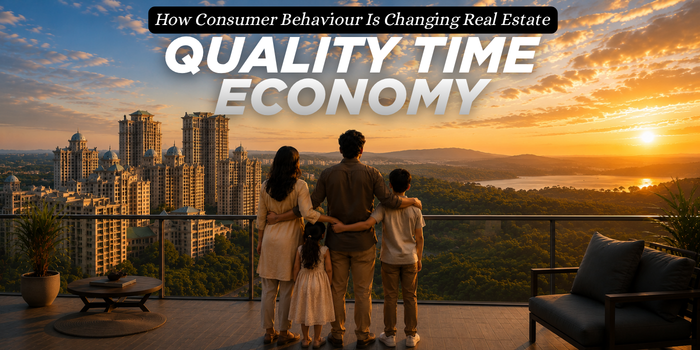
A family's day moves between work, school, hospital, park, and home. When each of these is a separate journey across the city, the real cost isn't measured in kilometres — it's measured in hours a family never gets back. That is why time itself has become the real luxury the industry is being asked to deliver.
This is exactly why integrated townships are reshaping luxury real estate in India. At Hiranandani, development has always been planned at the scale of the neighbourhood, not the individual building. Hiranandani Gardens, Powai is the clearest proof of this philosophy in action. It was never conceived as a set of residential towers — it was conceived as a working neighbourhood, with homes alongside schools, hospitals, offices, and green spaces, all planned together. Decades later, Powai isn't just a residential address. It's a self-sufficient urban destination, and one of the most cited benchmarks for integrated township development in India.
How Connectivity Redefines Real Estate Value
Location still matters. It always will. What has changed is the geography of opportunity.
For generations, an address was valuable simply because of how close it sat to a city centre. That is no longer true. New commercial hubs are emerging. Infrastructure is opening corridors few would have predicted a decade ago.
The industry has watched this first-hand — a location once considered peripheral becoming the centre of gravity for an entire region, purely because connectivity caught up to it. This is the new reality of connectivity in real estate: it is no longer about the distance between two points on a map. It is about how much of the city becomes accessible from where a family lives — job options, schools, healthcare choices.
Developers can no longer ask only where a neighbourhood sits today. The industry has to ask what it will connect people to tomorrow. That forward-looking view of connectivity in real estate is, increasingly, what separates ordinary developments from genuine luxury real estate in India.
Community Living - Real Luxury
There is one thing no floor plan can sell: belonging. Buildings get built to spec. Communities don't work that way — they take time, and they cannot be rushed or manufactured.
Across Hiranandani neighbourhoods, this has played out the ordinary way, over and over. Children who meet at school stay friends for life. Parents who meet on an evening walk become old friends. Neighbours become family. That cannot be manufactured. It can only be given the conditions to happen — which is exactly what community-first, integrated townships are designed to do.
As cities grow denser and daily life grows more digital, this matters more, not less. People need efficiency. They also need a park bench and a familiar face at the end of the day.
From Building Homes to Building Lives
The real estate industry has changed enormously over the decades — from single buildings to neighbourhoods to entire integrated townships. The real shift isn't in what gets built. It's that homebuyers today finally recognise the value the industry's best developers have believed in for decades. A family is not buying square feet. They are choosing where their children grow up, where careers unfold, where an entire life gets lived. That is a bigger responsibility than any brochure can capture.
So the real question is never whether a good building has been designed. It is whether a good place has been built — one that can adapt, mature, and still be worth living in decades from now. That, ultimately, is the real test of luxury real estate in India.
The Hiranandani Definition of Luxury Real Estate in India
Today's luxury is quieter than yesterday's. It is time given back to a family. It is a park instead of a traffic jam. It is belonging — the moment a collection of buildings turns into a genuine community.
The pursuit was never "more" for its own sake. It has always been about what lasts.
Decades in this business have made one thing clearer than ever: a development is not judged by how it looks on the day it is finished. It is judged by what it becomes — does it give people their time back? Does it create opportunity? Does it bring people together and keep them together, generation after generation?
That is the Hiranandani way. Perennial.
Frequently Asked Questions
What defines luxury real estate in India today?
Luxury real estate in India today is defined less by size and finishes and more by convenience, connectivity, and community — how much time and opportunity a neighbourhood gives back to the people living in it.
What is an integrated township?
An integrated township is a residential development planned alongside the infrastructure a community actually needs — schools, healthcare, commerce, and green space — so daily life doesn't depend on long commutes across the city.
Why is Hiranandani Gardens Powai considered a benchmark for integrated development?
Hiranandani Gardens Powai was planned as a complete neighbourhood — residential, education, healthcare, commerce, and green space developed together rather than in sequence — and has matured over decades into a self-sufficient, live-work-learn destination.
How does connectivity affect real estate value?
Connectivity determines the range of opportunities — jobs, schools, healthcare — accessible from a home, not just its physical distance from a city centre. Strong connectivity can turn a peripheral location into an established urban destination over time.
Explore Hiranandani's integrated townships — from Hiranandani Gardens Powai to Hiranandani Estate Thane — and experience what luxury real estate in India looks like when it's built around life, not just an address.





0 Comments